Preview Environments from the CLI
A preview environment is a per-branch (usually per-PR) clone of an existing env — production, staging, anywhere — that stands up when code changes and tears down when it merges. The CLI command for the entire lifecycle is one line:
mass environment preview pr42 -f preview.yaml
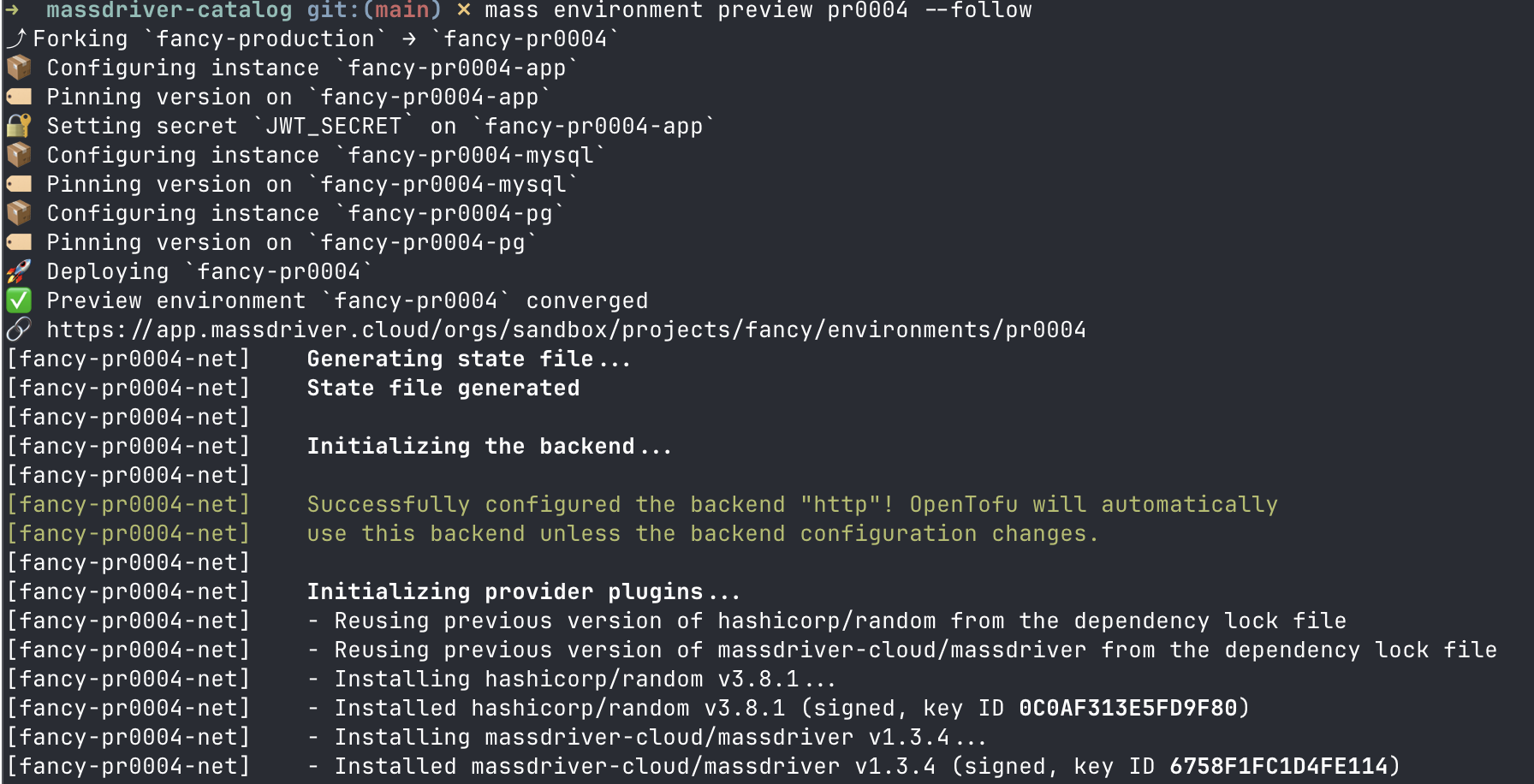
This is the four primitives — forkEnvironment,
setEnvironmentDefault, copyInstance, deployEnvironment — composed
behind a single declarative config. Every step is idempotent, so the
same command runs on open, on every push, and on the converge after a
rebase. CI doesn't need to track state.
The config
# preview.yaml — minimum viable form.
project: demo
baseEnvironment: production
That's enough to fork demo-production into demo-pr42, seed every
instance from the parent, and deploy. The full schema covers everything
the API will accept:
project: demo                # parity boundary
baseEnvironment: production  # the env we're forking

# Optional fork-level macros.
copyEnvironmentDefaults: true
copySecrets: false
copyRemoteReferences: false

# Required when the org gates `environment:create` on attribute policies.
attributes:
  region: us-east-1
  pr: "${GITHUB_PR}"          # ${VAR} expanded from process env

# Pin specific resources as defaults for this env.
environmentDefaults:
  - resourceType: aws-iam-role        # documentation; CLI uses resourceId
    resourceId: 161aeb95-...

# Per-instance overrides. Listed instances with no fields just inherit
# from the fork's seed.
instances:
  chatsvc:
    version: "latest+dev"     # `+dev` pulls from the dev release channel
    params:
      ingress:
        enabled: true
        host: chatty-pr-${GITHUB_PR}.example.com
    secrets:
      - name: STRIPE_KEY
        value: ${STRIPE_TEST_KEY}
    remoteReferences:
      # Fill chatsvc's `kubernetes_cluster` connection slot with a shared
      # cluster from another project (UUID form).
      - resourceId: a1b2c3d4-...
        field: kubernetes_cluster
      # Or address another instance's output: `<instance-id>.<field>`.
      - resourceId: demo-prod-db.hostname
        field: database
See the full reference in Applications → Preview Environments.
The flow mass environment preview executes
forkEnvironment— creates<project>-<ID>(or returns the existing one), seeds instances from the parent, optionally fans thecopy*macros.setEnvironmentDefaultper entry inenvironmentDefaults— pins the declared resources as defaults for this env.- Per-instance overrides — for each
instancesentry, applies the declared params (deep-merged viacopyInstance), version, secrets, and remote references. deployEnvironment— fans a provision deployment across every instance in dependency order.
Re-running converges. Edited an instance manually mid-PR? The next
preview run resets it. Forgot copySecrets on the first call?
Add it to the YAML and re-run; secrets backfill.
Environment-variable expansion
${VAR} / $VAR anywhere in the YAML is expanded from the process
environment before parsing. This is the contract for piping CI metadata
into the config without templating the whole file:
attributes:
  pr: "${GITHUB_PR}"

instances:
  chatsvc:
    params:
      host: chatty-pr-${GITHUB_PR}.example.com
    secrets:
      - name: STRIPE_KEY
        value: ${STRIPE_TEST_KEY}
Undefined variables expand to empty strings — same semantics as
os.ExpandEnv.
A GitHub Actions example
name: Preview Environment

on:
  pull_request:
    types: [opened, reopened, synchronize, closed]

jobs:
  preview:
    runs-on: ubuntu-latest
    env:
      MASSDRIVER_API_KEY: ${{ secrets.MASSDRIVER_API_KEY }}
      MASSDRIVER_ORG_ID:  ${{ secrets.MASSDRIVER_ORG_ID }}
      GITHUB_PR:          ${{ github.event.pull_request.number }}
    steps:
      - uses: actions/checkout@v4
      - uses: massdriver-cloud/actions/setup@v5

      # Converge on open / reopen / synchronize. Env identifiers can't
      # contain dashes, so the PR number sits right against the prefix.
      - name: Converge preview env
        if: github.event.action != 'closed'
        run: mass environment preview "pr${GITHUB_PR}" -f preview.yaml

      # Tear down on close / merge. `decommission` runs the per-instance
      # teardowns in reverse dependency order; `--follow` blocks until
      # every instance is gone so the subsequent `delete` (which
      # requires an empty environment) succeeds.
      - name: Decommission preview env
        if: github.event.action == 'closed'
        run: |
          mass environment decommission "demo-pr${GITHUB_PR}" --follow
          mass environment delete "demo-pr${GITHUB_PR}"
When to drop down to primitives
preview is convenient but not load-bearing. If your team wants a
different composition — say, fork on open, hold on to the env across
PRs, promote configs from main into it — drive the primitives
directly:
mass environment fork ecomm-production pr42 --copy-environment-defaults --copy-secrets
mass environment default ecomm-pr42 <shared-vpc-resource-id>
mass instance promote ecomm-staging-app --to ecomm-pr42-app
mass environment deploy ecomm-pr42

# When the PR merges:
mass environment decommission ecomm-pr42 --follow
mass environment delete ecomm-pr42
Same APIs. Same outcomes. Same idempotency guarantees.
Reference
- CLI command:
mass environment preview— see thepreviewsubcommand. - Full schema reference: Applications → Preview Environments.
- Primitives this composes:
fork,promote,setEnvironmentDefault,deployEnvironment,decommissionEnvironment.